


Start removing assists and improve driving technique.
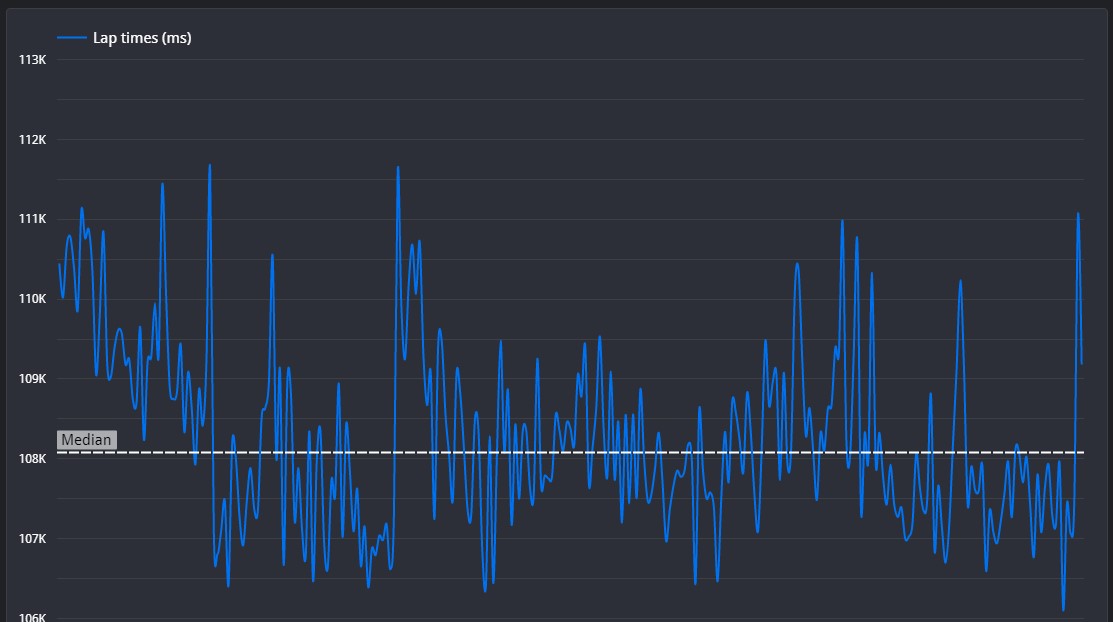
The theoretical time is coming down nicely and it is time to finish removing your assists. If they are still running you'll be causing issues which will be hard to detect and will change how you are learning a track. For example the braking points will be different and your throttle work will be off.
When you send through your next session. Write down all the assists that you are still using. Let's get these braking points nailed and remember on slow corners brake hard and fast whilst on fast speed corners be more gentle so you don't lose too much speed. It is easier to retain speed in the car than to have to accelerate again. Write down the lowest gear that the reference lap uses for each corner on your next track and try to remember and copy them.

As you brake through the corner and then turn your thoughts to the exit, there is a tendency to feel the lower gear will give you a faster exit. This can be counter productive when pushing the upper limits of the engine
Nearly 18% of all your mistakes are based on having too low a gear.
An example can be found in segment 1. If you check the gear number (inside the wheel graphic), this is a gear too low.
If the car is feeling sluggish or is revving too high, this is a good indication that you are in too low a gear. If you feel this might be the case, start a new session and drive two laps, first in the suspected wrong gear and then one gear higher. Check out your live delta, it'll give you your answer. The problem will always be there if you are still driving with gearing assist on.
A mistake that was seen in your first week of training. This skill is important to develop and really helps reduce lap times
This mistake happens a lot; in fact almost 16% of your mistakes can be attributed to this.
Look at where you brake on segment 11, as a whole, the corner is well handled. There are a number of factors that cost you time. Gear choice and failing to get on the gas quick enough
.
Braking late is not just a matter of putting your foot down at a later point on track. There are other secrets to it that are outlined in this video guide on braking later.
Trail braking is all about using the brakes to your advantage beyond the main braking phase. Rather than just coming on and off the brakes, you trail off the brakes gently as you start to turn in. This enables you to brake later but more importantly, it keeps more weight of the car on the front wheels which gives them more grip.
With approximately 10% of all of your mistakes being this one, it is still a relatively common mistake and learning this skill is important
A good example can be found in segment 7. You use the brake pedal like a switch when ideally, you would smoothly manipulate the pressure like the reference lap.
Even though it'll feel unnatural, attempt to create this fading off of the brakes on the corner entry. Depending on your sim rig setup, you might find you can just gently lift your foot's ball and toe area. Otherwise you might find that, to practice, a more exaggerated rising of the foot is necessary. Persist with this until you start to develop a muscle memory for the trail braking technique.
©Track Titan 2026. All rights reserved


