

"Trail braking is a driving technique where the brakes are gradually released while entering a turn to transfer weight to the front of the vehicle, improving grip and control."
Trail braking is one of the essential skills that drivers must master to take their performance on the track to the next level. It is a technique that allows drivers to apply / maintain a small amount of brake pressure as they approach the apex of a corner, keeping the weight on the front of the car as it turns. The skill is not easy to master, and even seasoned drivers can struggle with it, but it is what separates great drivers from good drivers and novice drivers.
The primary goal of trail braking is not to slow down the car but to keep weight on the front nose of the car as it turns. Doing so helps in two ways; it allows drivers to shift their braking zone closer to the apex of the corner, thereby maximizing time spent at full throttle. Additionally, it helps the car get rotation at corner entry through the apex, allowing for a better car angle at the apex and earlier and more aggressive unwinding of the steering wheel at the corner exit.
Not all corners require trail braking. For instance, high-speed corners where drivers do not need to brake at all on corner entry do not require trail braking.
Learning how to trail brake can be broken down into three stages. The first stage is identifying where the initial throttle application spot comes in. It is essential to develop discipline in this area, as drivers should not apply throttle until they reach the apex, and until they can start to unwind the steering wheel. This helps to maintain weight on the front nose and promote car rotation, which is essential for driving at a high level.
The second stage is to learn to maintain a light brake pressure to extend the brake zone for corners with typically short brake zones. This technique is ideal for high-speed corners where some braking is necessary, but less weight should be transferred to the front end to keep the rear more settled.
The final stage is to experiment with the line for where a good level of rotation turns into too much rotation, as it is essential to find the right balance between rotation and understeer. It is crucial to develop the skill to control the car at the limit and find the limit on the track.
In conclusion, drivers who can learn to maintain weight on the front nose of the car as they turn will find themselves spending more time at full throttle and accelerating earlier out of corners.
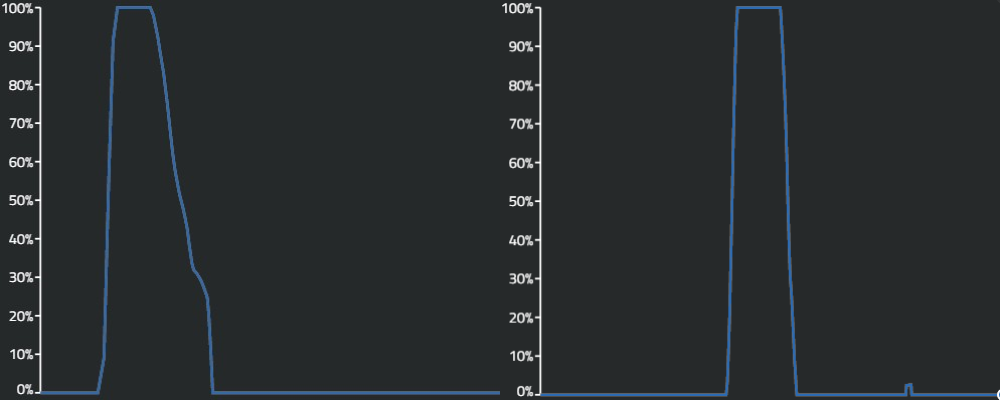
As you can see the graph on the left has a sharp incline until the car is slowed to the desired speed. In this can 100% braking pressure was required. At the point of slowing the car the driver begins his turn in and eases gently off the brake. Controlling the speed of release will help control the angle and weight of the car. In contrast the graph on the right, the driver brakes, holds 100% braking longer then lifts completely off the brake pedal. The time at 100% braking probably slowed the car down too much but just as importantly, it would have unbalanced the car creating an unstable car that could react unpredictably.
©Track Titan 2026. All rights reserved


