

The turn-in point is the moment when a driver begins steering into a corner, setting up the vehicle for the optimal racing line and thus their exit speed out of the corner.
The turn-in point is crucial because it affects the racing line and therefore important to allow the driver to carry the most speed through the corner. By choosing the correct turn-in point, the driver can set themselves up for the best possible exit speed from the corner. So how do you determine the best possible turn in point? This comes from a mixture of track knowledge and experience but there are some basic rules to help you understand as a starting base for you to experiment from.
Early Apex: Choosing an early apex means you aim to reach the innermost point of the corner earlier in the turn. This approach can have a few advantages:
However, an early apex also has some potential drawbacks:
Late Apex: Opting for a late apex means delaying your turn-in and aiming to reach the innermost point of the corner later in the turn. This approach offers a few benefits:
However, there are potential downsides to a late apex:
If you opt for an early apex, your turn-in point will be earlier, closer to the corner's entry. Conversely, if you choose a late apex, your turn-in point will be later, closer to the midpoint of the corner. Adjusting the turn-in point allows you to position your vehicle accordingly to hit the desired apex.
With all this information, you can see that there are many factors to consider. Also, it is very important to understand that the corners are not all separate entities, they are are joined and relate the straight before and the straight after. Not to mention complex corners where one corner flows into the next.
The the general rule is the tighter the corner the later the apex you can take in order to ensure you have a good fast exit out of the corner, the shallower the corner the more you'll be able to take the geometrical line which should be the fastest line through the corner and this is closer to an early or mid point apex.
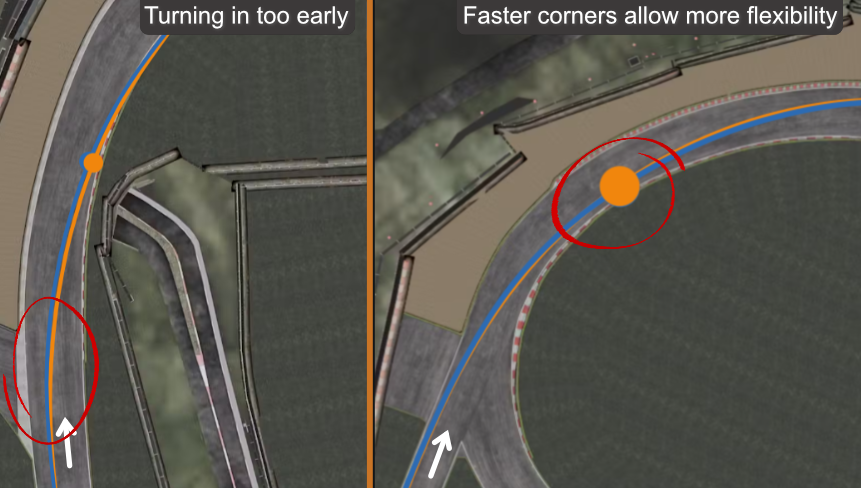
On the diagram on the left you'll see that a late turn in of the reference "blue" line at the beginning of the corner then allows, if the car has turned enough to be able to get your foot down earlier and faster on the exit from the corner. In the right hand diagram on a faster corner, it is possible to maintain your speed through the corner better so an earlier apex is fine, power on and plough through the corner. The tyres are more capable of maintain traction as there is less of a corner radius thus less lateral g-forces to contend with.
©Track Titan 2026. All rights reserved


