

"Fast into the corner, a fast apex and a fast exit. Speed is essential and power minimises how long you are in a corner."
"The corner starts as soon as you hit the brake pedal". With this statement in mind, it is also fair to say that the longer you are in the corner the slower your lap times. Creating a quicker braking phase initially comes from the rapid application of the brake pedal. When pressing the brake pedal as hard as possible have a clear understanding of what is going to happen to the car.
The basic motion when you apply the brakes is that the car will pitch forward and the weight will be transferred to the front of the car. Different car classes will react differently to the braking speed. In a car like the GT3 and F1 you want to get to 100% brake pressure as quickly as possible. This is so you can brake that tenth later and carry the cars speed in the corners. However, if you are driving a car where the brakes are much better then the engine power, you want to carry the car's momentum. This is achieved by not braking as hard and thus keeping the cars weight balanced.
The Mazda MX-5 is a perfect example of this, you could brake late and hard but you won't be as fast for two reasons. Firstly, the engine isn't less powerful to get back up to speed and secondly as the car shifts its weight, understeer will be created, making cornering slower and harder. Therefore in a slow road car you often want to be a little smoother on the brakes.
Just as the car class affects the braking, remember also, that the type of corner create a multitude of different scenarios. Braking hard on a downhill section will put more stress on your tyres to retain traction, whereas an uphill corner will allow you to brake later and harder.
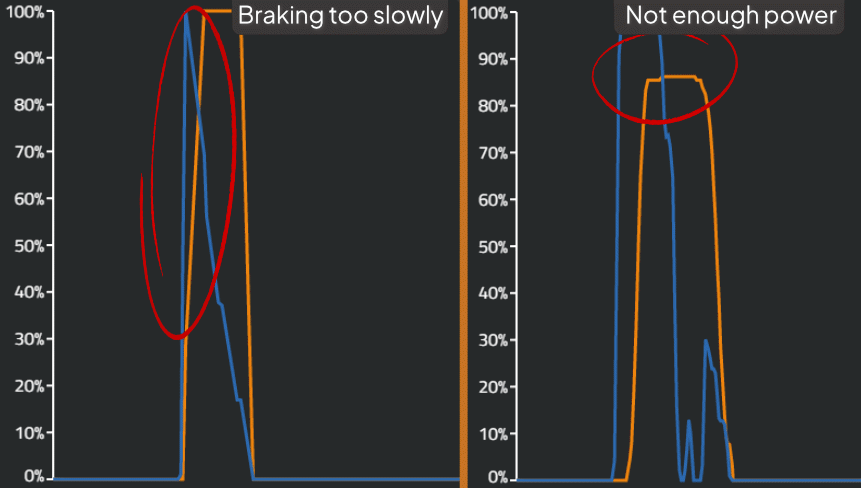
In the first image 'Braking too slowly' the driver isn't aggressive enough with their braking foot. It is taking longer than necessary to get to 100% braking pressure. Whereas, in the second image 'Not enough power' the driver was fast enough on the brake pedal, however, didn't slow the car down as quickly as possible due to not using the full capabilities of the car's brakes. Had the driver applied 100% brake pressure they would have needed to remain on the brakes for a shorter time, hence quicker.
©Track Titan 2026. All rights reserved


